





Golden Innovations
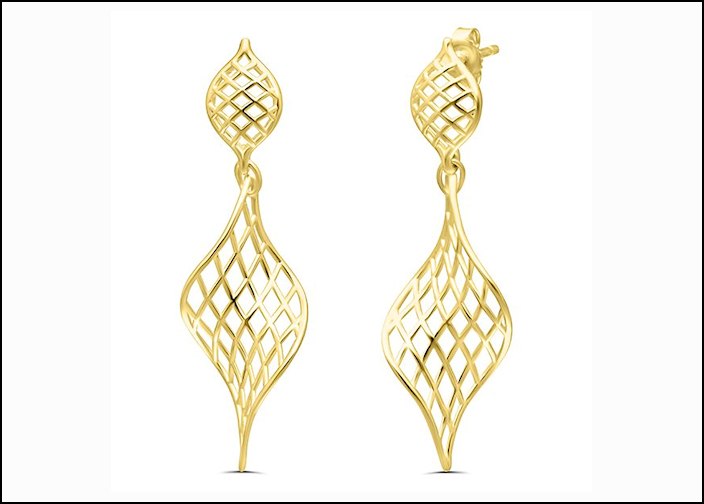
When the price of gold skyrockets, jewelry manufacturers scramble to adapt to rising costs of their core products. Technology plays a huge role in keeping costs under control.
“We have introduced lightweight hollow gold engineering using stamping, CNC-precision components for consistent quality, and modular jewelry systems that allow for large looks in lower price points,” explains Simran Shah, vice president of sales and company principal of Kama Jewelry.
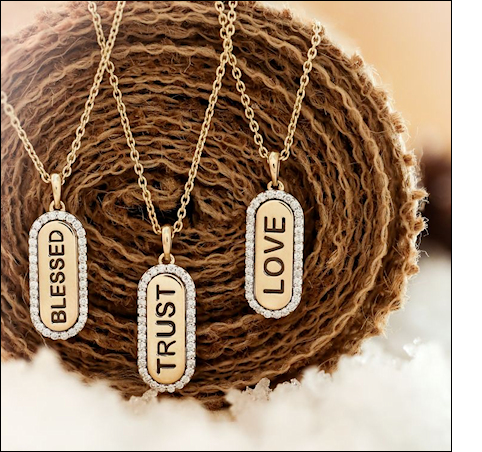
Kama Jewelry
Another tool is 3D printing, which allows for the fast creation of prototypes, less waste material, and the ability to make intricate styles. ODI / Original Designs employs some of these tech innovations as well.
“Our personalized Sentiments collection uses thin sheets of gold that are precision laser cut, for maximum surface area at minimal weight,” explains Valerie Fletcher, vice president of design and product development. “And for more intricate, dimensional designs, we use Direct Resin Casting to create large, open, lightweight designs that would not be possible using traditional rubber molds.”
Beyond tech, smart engineering is another way to make jewelry affordable. Think convertible earrings, modular chain systems, reversible pendants, and sculptural hollow gold forms.
“Our charm and chain system has been a key innovation for us,” says Shah. “It allows customers to reconfigure a single set into multiple looks without requiring custom manufacturing timelines. While it is not driven by a new patent or technology, it represents a modern approach to product strategy by encouraging personalization, styling versatility, and repeat purchases through an evolving collection. Innovation today is about balancing creativity, engineering, and commercial scalability. Our goal is to make forward design achievable for retail partners at realistic price points.”
Some of the principals from Quality Gold recently attended a jewelry trade fair in Italy, hoping to be wowed by tech innovations, but that didn’t happen. Instead, the Italian solution to high gold prices appears to be making everything lightweight and even using 9k and 10k gold. Some buyers noticed that Italian factories were indeed adjusting lines to accommodate lower karat gold jewels and for titanium, which has been in selective use in the industry for years at the high end.
Meanwhile, ODI recently unveiled a new collection that its vice president of manufacturing Dinesh Upadhyay calls “revolutionary.” Enter, Microlite, crafted using an advanced casting process that allows gold to be cast at significantly thinner gauges than traditional methods.
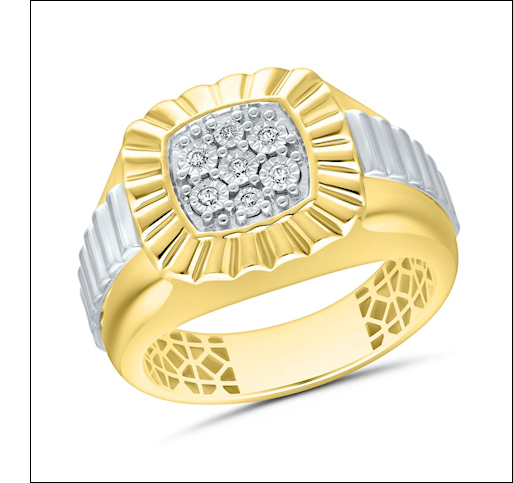
ODI / Original Designs
“While standard casted gold jewelry typically measures 0.8mm or more, Microlite pieces can be produced at thicknesses as low as 0.2mm,” Upadhyay explains. “Achieving this level of precision requires specialized casting equipment, proprietary alloy formulations, and carefully controlled post-processing. The result is jewelry that feels almost weightless yet maintains a luxurious and striking appearance and structural integrity—beautifully engineered gold jewelry that balances design, durability, and accessibility”.
Innovation often starts with retailer needs and market realities and is then brought to life through new design approaches and manufacturing techniques. Fashion trends inform aesthetics, while engineering and process innovation shape how those designs are executed. ODI is uniquely positioned in this regard, with vertical integration through our factory and a dedicated technical team focused on innovation.”